Rolandbal.com - just a quick touch up
Rolandbal.com: What They Do and Who They're Trying to Reach
The website rolandbal.com operates in the mental health and wellness niche, with a very specific and clear focus: resolving trauma and PTSD.
The site is run by Roland Bal, who uses a cognitive and somatic (body-based) approach to psychotherapy.
His target audience is individuals actively seeking help and resources for Complex Trauma, PTSD, and related symptoms like dissociation or the "fight-flight-freeze" response.
He provides resources through articles and a main offer of paid "Courses."
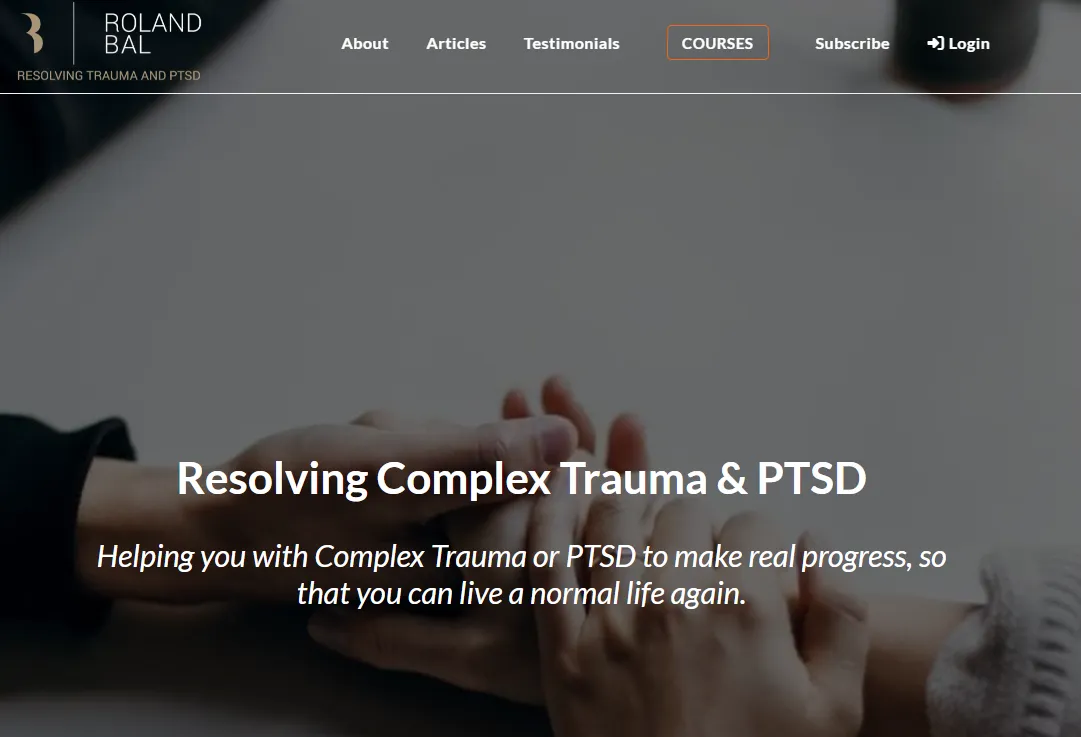
First Impressions: Does the Site Communicate Clearly?
Yes, instantly.
A first glance at the site (specifically its "Articles" page) shows a clean layout that avoids overwhelming the user—a critical choice for this particular audience.
- Clarity: The site's tagline, "RESOLVING TRAUMA AND PTSD," is placed directly under the logo, leaving no doubt about its purpose.
- Messaging: The messaging is direct and authoritative. Headlines like "Articles: Complex Trauma PTSD" are simple and clear. A subheading explains the articles are "based on real-life client-therapist interactions," which builds immediate trust and credibility.
- Visual Guidance: The site uses a simple two-tiered navigation. The main nav guides users to top-level pages like
About,Testimonials, andCourses. TheCoursesbutton is outlined, drawing the eye to the site's primary product. A secondary navigation bar (e.g.,Childhood Trauma,Symptoms,Healing) does an excellent job of helping users self-segment and find the exact information they need.
Overall, the site feels professional, credible, and easy to navigate.
Their Content Strategy: What Are They Publishing?
The site has an active "Articles" section, which functions as its blog. We're assuming the content is updated regularly.
The most important finding here is the focus of the content. The articles are almost entirely problem-focused.
Instead of publishing "feature updates" (like "My New Course is 10% Off!"), the content list is filled with titles that speak directly to the audience's pain points:
- "The Fawn Response Dilemma"
- "Why Healing from PTSD Is so Terribly Hard and What You Can Do About It"
- "PTSD Narcissism: The Dark Intersection..."
- "Trauma Is the Gateway to Addiction"
This is a high-empathy strategy. It validates the user's experience first, building trust before asking for a sale.
Questions Their Audience Is Actually Asking
The good news is that Roland's content strategy is already aligned with his audience's needs. He's covering deep, complex topics that his audience is likely struggling with.
However, by analyzing common online questions, we can spot a few clear gaps. His audience isn't just asking why they feel a certain way; they're also asking for practical, "in-the-moment" help.
Here are the question clusters his current content isn't fully answering:
Cluster 1: Diagnosis
- Audience is asking: "How can I tell if someone has PTSD?" and "How is PTSD officially diagnosed?"
- Opportunity: While he can't diagnose users, he could write an article on "The Official Diagnostic Process: What to Expect When Seeking Help" or "Signs vs. Symptoms: How to Recognize PTSD in a Loved One."
Cluster 2: Daily Impact
- Audience is asking: "What are the triggers of PTSD?", "How does PTSD affect a person's daily life?", and "What can happen if PTSD goes untreated?"
- Opportunity: This is a perfect chance for practical content. An article like "A Day in the Life with C-PTSD" could be incredibly validating. A post on "Identifying Your Triggers: A First Step to Regulation" would be a valuable resource.
Cluster 3: Healing & Coping
- Audience is asking: "What is the best therapy for PTSD?", "Does crying release trauma?", "What is the 3 3 3 rule for PTSD?", and "What can I drink to calm my nerves?"
- Opportunity: These are highly specific, action-oriented questions. He is missing a huge opportunity to provide quick, tactical advice. He could create content on "5 Somatic Exercises to Calm Your Nerves" or "Crying and Trauma: Does it Help?" This is low-stakes content that directly helps someone today.
Cluster 4: Specific Demographics
- Audience is asking: "How do you treat PTSD in children?"
- Opportunity: This question reveals a new audience segment: parents and caregivers. He could create a dedicated article or resource to address this specific, high-intent query.
Content Strategy Score: 5/5
Score: 5/5
This site earns a top score. The content strategy is almost entirely problem-focused, which is the gold standard for building trust with an audience dealing with sensitive, high-stakes issues.
The content is not "marketing"; it's a resource. The only minor critique is the presence of a few socio-cultural articles (on "Groupthink" and "War") that feel slightly disconnected from the immediate, personal needs of someone seeking help for their own trauma.
Suggestions for Improvement:
- Double-Down on "How-To": His current content is excellent at explaining the why (e.g., "Why Healing is Hard"). He should now add content that explains the how-to (e.g., "What to Do Right Now When You're Triggered").
- Answer the Practical Questions: Use the new "Healing & Coping" cluster (Cluster 3) to create a series of articles on practical techniques like the 3-3-3 rule or other grounding exercises.
- Address Adjacent Audiences: The "How do you treat PTSD in children?" query is a clear signal. He should create a piece of content specifically for parents or caregivers of those with trauma.